


Banding Online Together During COVID
- Lanea Bynum

- Nov 18, 2020
- 5 min read
Musicians Band Together and Find New Ways to Collaborate During COVID-19
A musician must explore new ways to reach their audience after the World Health Organization declared the coronavirus a pandemic in March of 2020. The daily reality of how entertainment is ingesting music has undergone a notable change due to COVID-19. With the increase in downstream and continual access to Wi-Fi, consumers have gravitated to visual entertainment forms such as social media and live streaming, while audio consumption has fluctuated.
Government agencies worldwide began locking down everything from commercial businesses and cultural centers to the entertainment industry's live venues. The countrywide shutdown also began limiting crowd sizes for movies, Broadway shows, concerts, and other live performances. For enterprises that rely on social gathering for their revenues, the recent closures and limited capacity has been detrimental.

Closed Sign (2020)
Fast forward a few months later, and the country began lifting restrictions. Some states did so faster than others. As the COVID numbers began to recede, most people became relaxed and carefree. Industries worldwide started re-opening, and gatherings increased.

COVID 2nd wave (2020)
As fall approached, so did the "second wave" of corona outbreaks. The increase was fast and swift, and the successes and failures of different governmental approaches had come into focus.
The United States had surged in flu-like symptoms across the region. Without a vaccine in sight, individuals had become vulnerable. The nation had seen a continuum of services shut down, and businesses started limiting services.
Coronavirus had forced the music industry to be creative, leading to a new routine as a new way to keep their audience engaged. In March of 2020, when the pandemic first began, streaming declined by up to 8.8%, which is a rarely seen decline (Grant, 2020). According to the report, there has been an incline by two percent in streaming, and it continues to rise (Grant, 2020).
As COVID fuels online collaborations between artists, the number of artists engaging in live streaming has surged across platforms such as Instagram, YouTube, and Twitch. According to Grant (2020), the Music and Performing Arts category rose by 544% from an average of 92,000 viewers to 574,000 viewers.
The collaborations between media organizations and artists are being exploded over time. The pandemic began by galvanizing efforts to support musicians impacted by the pandemic through reaching out to fans feeling isolated from COVID-19.
The entertainment industry continues to be predominant, functioning at a limited capacity since COVID began. Twenty-five percent of limited capacity has led to only 25% of revenues for entertainers ( World Health Organization, 2020). In a personal interview with World-renowned Saxophonist Tony Exum Jr., Exum (November 7, 2020) said it would be tricky to keep things familiar during the second wave.
The extended closures enlightened the damage that COVID has inflicted on the entertainment industry. Bar Closures and non-essential businesses have continued to wreak havoc on the Entertainment Industry and revenue sources. The change has been considerable. It’s impacted everything from the restricted service industry and food supply to venues and travel.
Travel restriction from individual states has also created an enormous disadvantage on the industry, causing musicians to either not travel to these particular states or self-quarantine for 14 days. According to Aja Tally (2020), "Travel has been chaotic” (personal communication). She believes the masks make it difficult to breathe when traveling through the airport, and services and support between airlines should be universal. Aja Tally (2020) continues to say, “As a parent, I have to worry about if travel is safe for my family and me. Will I be taking something home to my family, me? Of course, we want to get out there and do your job, but is it safe?" Promotor Breanna Jennings (November 6, 2020) wondered in a personal interview, “how can we all thrive? I guess as far as music goes and finishing projects, the good thing is it is 2020.” " Jennings ( November 6, 2020) continued to say, “You don't necessarily have to be always in the booth or in the room with someone to create something great you could still make a nice piece or project without even seeing the other person."
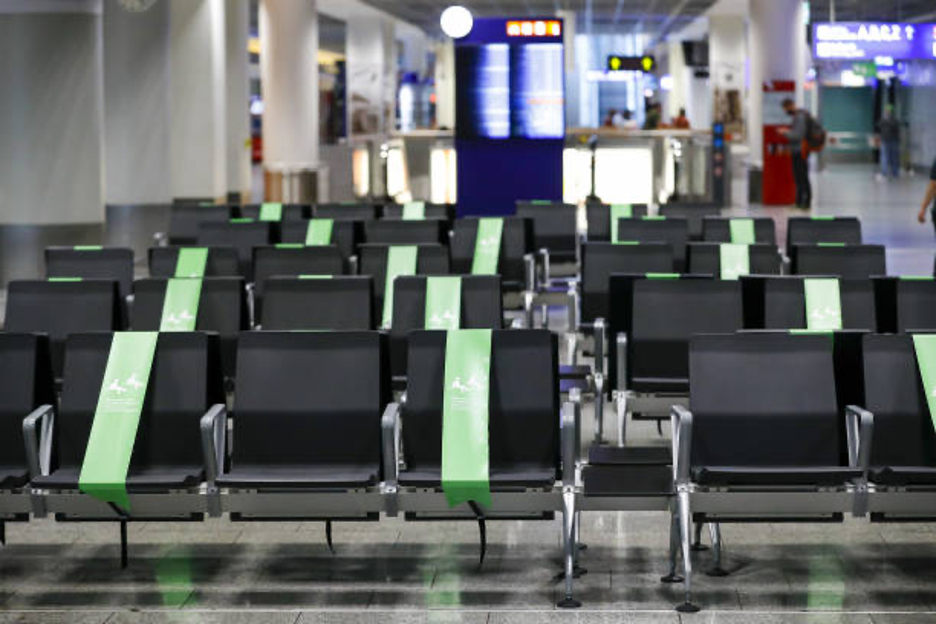
Airport (2020).
COVID-19 has caused many musicians and performers to continue their creativity by moving their works and performance online. "This will have an enormous impact on the revenues" (Exum, personal communication, November 7, 2020). "It would be difficult to project your revenue at this point. There are too many factors in play at this time to determine the outcome" (Jennings, personal communication, November 6, 2020). "I guess we could enjoy a concert via zoom, but there is no engagement with the audience. That can be a problem within itself. Functioning at 25% or less capacity makes it hard to sell out a venue. If you want to eat, you must perform, and how can you perform online and still be able to connect with the audience?" (Jennings, personal communication, November 6, 2020).

Tony Exum, Jr. (Bynum, 2020)
Because social distance is a new concept for musicians, and because they are used to being around other creative energy or playing with a band, the coronavirus has made it extremely challenging. There is Google Hangout Open Mic, a platform to share music with others by using video chat-based services such as Skype and Zoom.
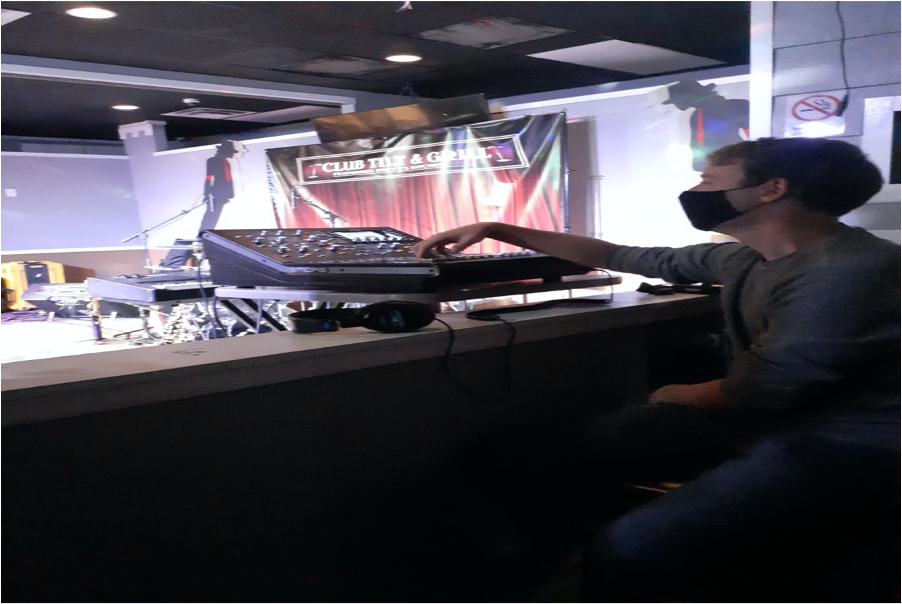
Soundboard (Bynum, 2020).
Collaborations can quickly be done with remote recording collaborations. Social distancing has provided a perfect opportunity to create new music by using a digital audio workshop (DAW) such as Pro Tools, Audacity, and Sound Trap. StageIt or Periscope can be utilized and makes collaborations with others easy and simultaneous.
JQBX.fm is a contemporary music app that lets you listen to music coordinated with others worldwide. Users can then search or save the music by joining a private or public room to become the DJ themselves, which allows for a certain level of self-distribution. Music apps can increase independent music distributed to the public, but it also uses webcasting and on-demand downloads. Applications such as these are in the audience's best interest from a social distance standpoint and supply an increased compensation perspective for the artist.
Online collaboration is not the only issue facing the artists of 2020-2021 or longer. Collaborating online takes months of rehearsing, recording, and producing. A luxury that some musicians do not have. Especially since COVID has been around for several months, many musicians need to have some sense of normalcy or at least what used to be expected to maintain creativity. The lack of audience engagement can also be even more challenging. "Without the cheers and the clapping, it is difficult to feel connected to the viewer" (Benford, personal communication, November 5, 2020).
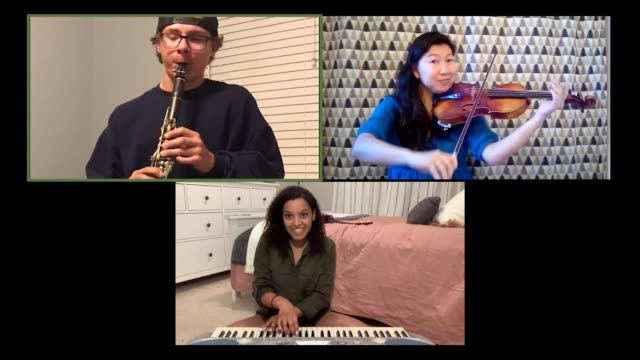
Musician Collaborating (2020)
Although there has been a growing interest in factors contributing to online collaborations' effectiveness, there still are some concerns about their monetary outcome. There are some strengths to online partnerships, including the ability to compare ideas, collaborate, share knowledge and skills with other participants, and manage workload. Other aspects include technology competence, utility, and resourcing.The best part of it all is that the musician will not have to leave their home.

Stage photo (Bynum, 2020).
"The reality is that the Arts and Entertainment professionals will be among the last to be able to return to work safely". It will be the new normal; therefore, the artist must continue to be creative and learn a new way to be creative and collaborate from a distance.

Infographic (Bynum, 2020)
References
Christman, E. 2020, April 7). Coronavirus Listeners Data: Streams and Digital Download Billboard. https://www.billboard.com/articles/business/9352805/coronavirus-listener-data-streaming-downloads-album-sales.
Henderson, M. (n.d.). Ways for Musicians to Collaborate while Practicing Social Distancing. Berklee Online. https://online.berklee.edu/takenote/5-ways-for-musicians-to-collaborate-while-practicing-social-distancing-amid-the-coronavirus-outbreak/
Grant, W. (2020, May 16). The Future of Music Streaming: How COVD-19 Has Amplified Emerging Forms of Music Consumption. Forbes. https://www.forbes.com/sites/kristinwestcottgrant/2020/05/16/the-future-of-music-streaming-how-covid-19-has-amplified-emerging-forms-of-music-consumption
Kaiser Family Foundation. (2020, November 16). Health costs issue brief State data and Policy Actions to address Coronavirus. https://www.kff.org/health-costs/issue-brief/state-data-and-policy-actions-to-address-coronavirus/
Image Reference
Airport [Stock image]. (2020). https://pixabay.com/
Bynum, L. (2020). Stage photo [Photograph].
Bynum, L. (2020). Infographic [Image].
Bynum, L. (2020). Soundboard [Photograph].
Bynum, L. (2020). Tony Exum Jr. [Photograph].
Closed Sign [Stock image]. (2020). https://www.shutterstock.com/
COVID 2nd Wave [Stock image]. (2020). https://pixabay.com/
Musicians Collaborating [Stock image]. (2020). https://pixabay.com
Comments